Boat Speedometer — Real-Time Marine GPS Speed Tracker & SOG Tool
Check true marine Speed Over Ground (SOG), calibrate mechanical transom paddlewheels, enforce harbor no-wake speed limits, and record maximum offshore velocity in knots, mph, or km/h.
How to Check Boat Speed Online in 3 Simple Steps
-
1. Open the Marine Speedometer Tool
Launch this page on your phone or marine tablet via Safari, Chrome, Edge, or Firefox. You can also install this tool as a Progressive Web App (PWA) for instant 1-tap full-screen access from your helm console with zero app store downloads.
-
2. Enable High-Accuracy Geolocation
Tap Start Trip and select “Allow While Using App”. Place your phone in a waterproof helm cradle or dashboard mount with an unobstructed view of the open marine sky.
-
3. Monitor Live Marine SOG Telemetry
As you advance the throttle or trim your sails, the digital dial displays your instantaneous Speed Over Ground (SOG). Toggle between Knots (kn), MPH, and KM/H, or switch to dark HUD mode for night coastal passages.
Planning an extended coastal passage and want to track cumulative voyage mileage? Explore our Speed Tracker Telemetry Hub.
How GPS Measures a Moving Boat’s Speed Over Ground (SOG)
Unlike mechanical boat speedometers mounted on the transom, an online GPS Speedometer calculates vessel velocity using fundamental satellite radio physics:
- Doppler Velocity Calculation (Δf): Satellites continuously broadcast precision atomic clock signals. By measuring the minute frequency compression of incoming radio carriers across multiple satellites simultaneously, your phone calculates exact velocity relative to Earth’s center.
- Immunity to Water Drag & Cavitation: Traditional transom sensors suffer from turbulence, boundary layer drag, and propeller aeration. GPS calculates speed purely from orbital triangulation, completely immune to hull hydrodynamics.
- Geodesic Distance Delta (Δd/Δt): Second-by-second coordinate fixes calculate nautical voyage distance using the Great-Circle Haversine equation.
Traveling by air or high-speed rail instead? Check out our Flight Speed Tracker and Train Speed Guide.
GPS Speed (SOG) vs. Marine Dashboard Speedometers (STW): Why Readings Differ
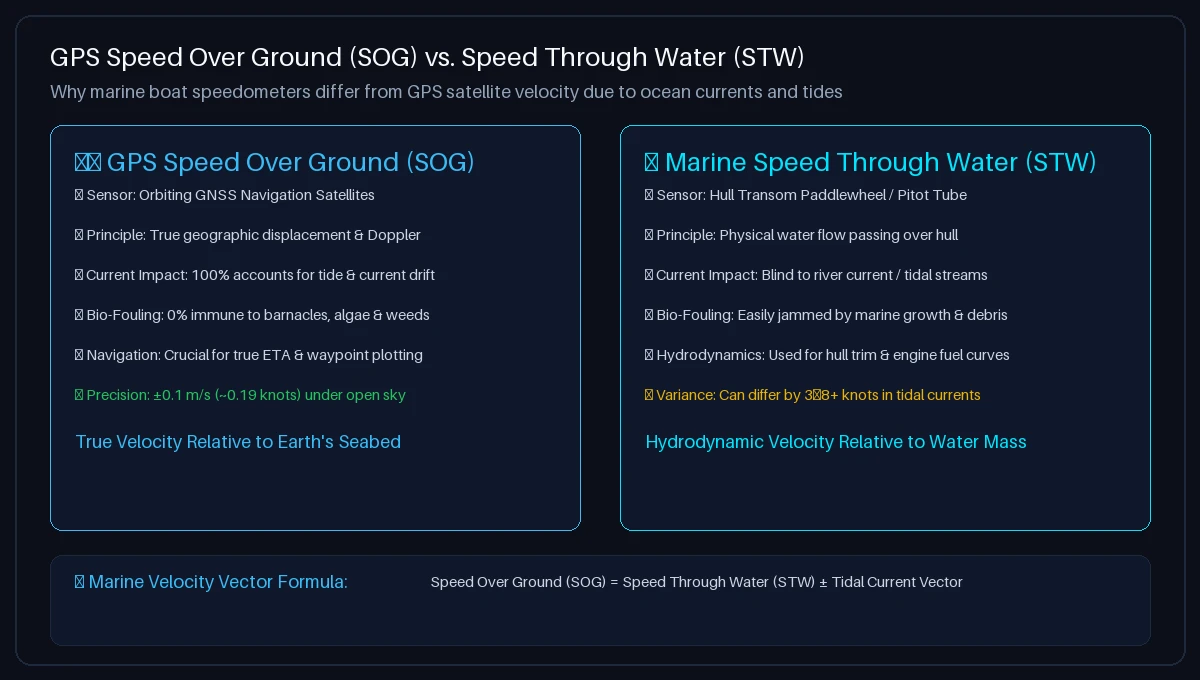
Here are the primary hydrodynamic and mechanical reasons why your boat’s dashboard gauge differs from GPS:
- Tidal Currents & River Flow: If your boat is cruising at 10 knots STW downstream with a 3 knot river current, your GPS SOG will read 13 knots. When motoring upstream against that same current, your GPS SOG drops to 7 knots, even though the dashboard gauge still reads 10 knots.
- Paddlewheel Bio-Fouling: Transom paddlewheels are prone to becoming jammed or restricted by marine algae, seaweed, barnacles, and silt. A fouled paddlewheel under-reports speed or drops to zero entirely, while GPS remains 100% operational.
- Pitot Tube Clogging: Water-pressure pitot tubes on outboard lower units frequently clog with lake mud, sand, or wood pulp, causing the needle to stick. GPS operates independently of water intake.
Want to benchmark your vessel’s gauge calibration? Follow our step-by-step Speedometer Accuracy Test Protocol.
Marine Speed Measurement Units: Knots vs. MPH vs. KM/H
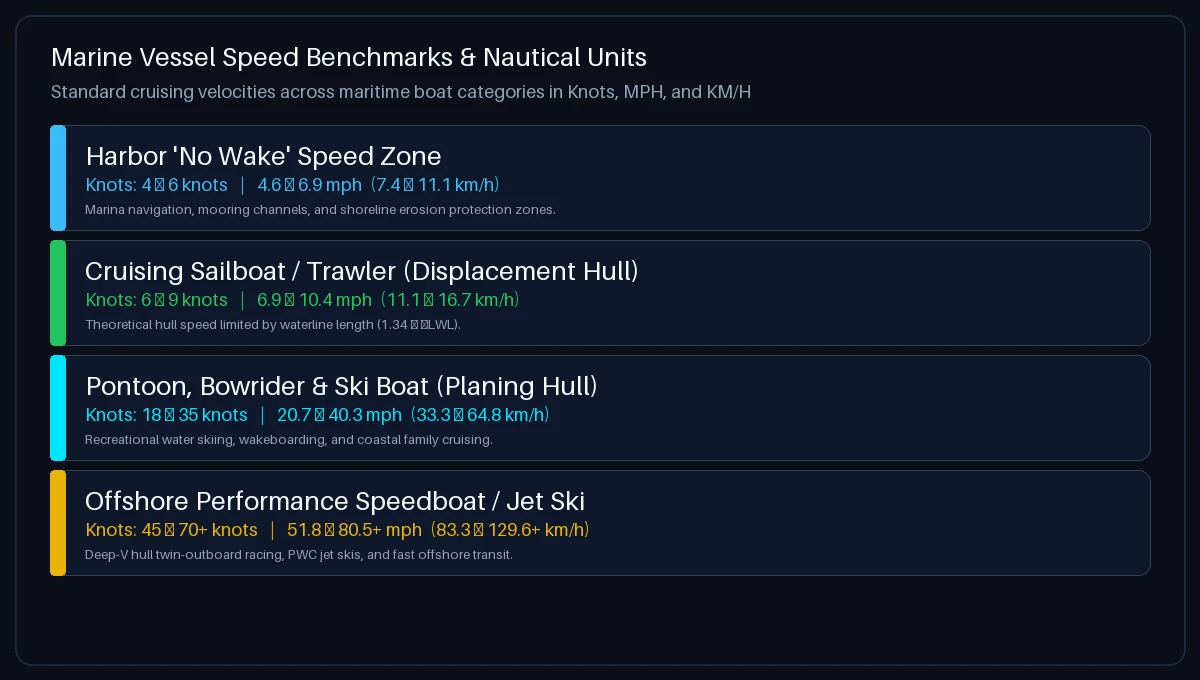
Here is a quick reference table showing standard maritime velocity benchmarks across vessel categories:
| Marine Navigation Zone / Vessel | Knots (kn) | Miles / Hour (mph) | Kilometers / Hour (km/h) |
|---|---|---|---|
| Harbor “No Wake” Speed Zone | 4 – 6 kn | 4.6 – 6.9 mph | 7.4 – 11.1 km/h |
| Cruising Sailboat (Displacement Hull) | 6 – 9 kn | 6.9 – 10.4 mph | 11.1 – 16.7 km/h |
| Pontoon & Bowrider (Planing Hull Cruise) | 18 – 35 kn | 20.7 – 40.3 mph | 33.3 – 64.8 km/h |
| Offshore Go-Fast Speedboat / Jet Ski | 45 – 70+ kn | 51.8 – 80.5+ mph | 83.3 – 129.6+ km/h |
| Commercial Container Ship / Ferry | 18 – 24 kn | 20.7 – 27.6 mph | 33.3 – 44.4 km/h |
Need to convert custom nautical measurements? Use our interactive Speed Converter Calculator.
Factors Affecting Boat GPS Accuracy on Open Water
Keep these marine environmental factors in mind when taking readings on the water:
- Open Water Line of Sight: Lakes and oceans offer optimal GPS conditions with zero tall buildings. Mounting your phone on a waterproof helm bracket ensures a clear lock on 12+ navigation satellites.
- Wave Chop & Vertical Pitch: In rough seas, vertical pitching and heaving adds slight cyclic oscillation to the instantaneous 3D velocity vector. Our tool applies Kalman filtering to smooth out wave surges and deliver stable cruising readings.
- Enclosed Cabin Shielding: Operating a phone deep inside a thick fiberglass or aluminum below-deck cabin attenuates satellite radio signals. Always position the device on the open bridge or near a deck window.
Looking for road and motorcycle tools? See our Car Speed Test and Motorcycle Speedometer Guide.
Crucial Boating Safety Guidelines: Helm Lookout First
Follow these essential maritime safety practices:
- Pre-Departure Setup: Launch the website, tap Start Trip, select your unit (Knots, MPH, or KM/H), and secure your phone in a waterproof marine cradle before casting off your mooring lines.
- No-Wake Zone Compliance: Use the speedometer to verify that your SOG stays strictly within harbor no-wake speed limits (typically 4–6 knots) to prevent shoreline damage and protect moored vessels.
- Primary Navigation Equipment: This online speedometer is an auxiliary telemetry tool. Always rely on certified marine chartplotters, paper nautical charts, depth sounders, and visual bearings for primary navigational safety.
Want a quick conversational check of your speed right now? Try our live How Fast Am I Going Tool.
Frequently Asked Questions About Boat Speedometers
How can I check my boat speed online with GPS?
To check your boat speed online, open Boat Speedometer in your mobile browser, tap “Start Trip”, allow location permissions, place your phone on the helm console, and navigate. Your real Speed Over Ground (SOG) displays live in Knots, MPH, or KM/H.
What is the difference between SOG and STW on a boat?
SOG (Speed Over Ground) is your boat’s true speed over the Earth’s seabed (calculated by GPS). STW (Speed Through Water) is your speed relative to the water flowing past your hull (calculated by a paddlewheel or pitot tube). Ocean currents and tides cause SOG and STW to differ.
Why is boat speed measured in knots instead of mph?
Knots are based on nautical miles (1 nautical mile = 1 minute of latitude). This allows mariners and navigators to plot distances and chart coordinates directly on nautical charts without complex conversions.
How accurate is a phone GPS speedometer on a boat?
On open water with an unobstructed view of the sky, a smartphone GPS speedometer is typically accurate to within ±0.1 m/s (~0.19 knots or 0.22 mph) at steady cruising speeds.
Why does my boat’s paddlewheel speedometer stop working?
Transom paddlewheels frequently get clogged by marine weeds, algae, barnacles, or debris. Because GPS calculates velocity from orbiting satellites, it is completely immune to paddlewheel fouling.
What is a typical “No Wake” speed limit in harbors?
Most marina and harbor authorities enforce a “No Wake” or idle speed limit of 4 to 6 knots (4.6 to 6.9 mph / 7.4 to 11.1 km/h) to prevent wave damage to docked boats.
Do I need to download an app to check my boat speed?
No. This speedometer runs directly in your web browser. You can also save it as a Progressive Web App (PWA) for fast 1-tap helm access with zero app store downloads.
Does this tool work offshore out of cellular network range?
Yes. If you load this page before leaving cell coverage (or install the offline PWA), your phone’s internal GNSS receiver continues receiving satellite radio signals offshore without active mobile internet.
Does this website store or upload my boating routes?
No. Your privacy is 100% protected. All velocity calculations, peak speeds, and voyage statistics are processed locally in your device’s browser memory. No location or trip data is ever uploaded to our servers.
How do I convert knots to mph or km/h?
Use our interactive Speed Converter Calculator to instantly convert between knots, mph, km/h, and meters per second.