Train Speed — Check & Track Live Train Speed Online
Track real-time speed on commuter rail, regional intercity trains, and high-speed bullet trains (TGV, Shinkansen, ICE, Eurostar) — 100% private in your browser, no app installation required.
How to Check a Train’s Current Speed Online in 3 Steps
-
1. Launch the Train Speedometer
Open this page on your smartphone browser (Safari, Chrome, Firefox, or Edge). If you commute by rail regularly, you can install this tool as a Progressive Web App (PWA) for quick 1-tap full-screen access from your home screen.
-
2. Enable GPS & Hold Near a Window
Click Start Trip. When prompted, select “Allow While Using App”. Positioning your phone near a passenger carriage window bypasses the metal roof and structural shielding of the train car.
-
3. Monitor High-Speed Rail Telemetry
As the train accelerates out of the station, the digital gauge displays your instantaneous speed. Switch between KM/H and MPH, or track peak velocity and average journey pace in the bottom telemetry dashboard.
Looking to log and analyze your entire rail route from station to station? Explore our Speed Tracker Telemetry Guide.
How GPS Measures Velocity on a Moving High-Speed Train
Passengers do not need physical access to locomotive instrumentation. A browser-based GPS Speedometer calculates ground velocity through two core scientific principles:
- Doppler Frequency Shift (Δf): As the train travels across the rail network at speeds up to 350 km/h, incoming radio waves from navigation satellites orbiting at 20,200 km altitude compress or stretch according to the relativistic Doppler effect. By analyzing carrier phase shifts across 4 or more satellites simultaneously, the receiver calculates a 3D velocity vector (vx, vy, vz) every second.
- Geodesic Position Delta (Δd/Δt): The receiver calculates great-circle displacement between consecutive latitude and longitude fixes using the Haversine trigonometric formula, verifying cumulative track mileage and average velocity between rail stations.
Curious about how train velocity compares to other transportation modes? Compare with our guides for car speed testing, bus speed testing, and flight speed tracking.
Train Speed Measurement Units: MPH vs. KM/H
You can switch between international rail units on the fly with a single tap during your journey:
- Kilometers per Hour (km/h): Used by high-speed rail operators worldwide, where 300 km/h (186 mph) and 350 km/h (217 mph) represent top commercial benchmarks.
- Miles per Hour (mph): Standard for passenger and freight rail in the US and UK, where conventional passenger trains cruise between 79 and 125 mph (127–201 km/h).
- Meters per Second (m/s): The SI scientific unit, useful for physics analysis and rapid acceleration measurements (100 m/s = 360 km/h ≈ 223.7 mph).
Need to convert timetables or speed benchmarks between systems? Use our interactive Speed Converter Calculator.
How Fast Do Trains Go? Global Rail Speed Categories

When monitoring your live train speed, keep these established global rail categories in perspective:
- Commuter Rail & Subways: Regional commuter networks (e.g. London Overground, Paris RER, German S-Bahn) typically reach top speeds of 80–120 km/h (50–75 mph) between suburban stations, with average route speeds of 45–70 km/h due to frequent stops.
- Conventional Mainline Rail: Standard diesel and electric passenger trains (such as Amtrak Northeast Regional or UK CrossCountry) cruise at 120–160 km/h (75–100 mph), reaching up to 200 km/h (125 mph) on upgraded mainline corridors.
- High-Speed Rail Networks (HSR): Dedicated high-speed networks operate at sustained commercial speeds:
- TGV & Eurostar (France/Europe): Up to 320 km/h (199 mph) on LGV lines.
- Shinkansen Bullet Trains (Japan): 285–320 km/h (177–199 mph) on the Tokaido & Tohoku lines.
- ICE (Germany): 250–300 km/h (155–186 mph) on high-speed sections.
- CR400 Fuxing (China): 350 km/h (217 mph) on commercial revenue lines.
- Amtrak Acela (USA): Up to 150 mph (240 km/h) on specialized segments of the Northeast Corridor.
Want to check your exact speed right now while on board? Try our live How Fast Am I Going Live Tool.
Factors Affecting Train Speed Readings & Passenger GPS Reception
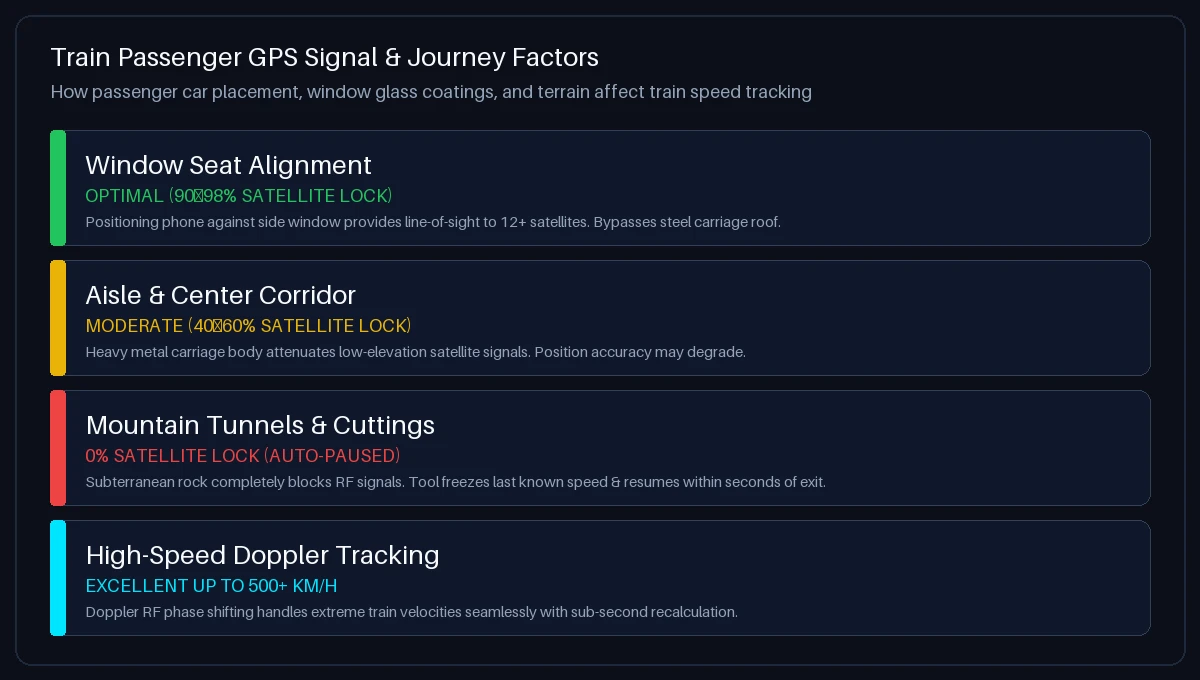
Keep these physical and environmental factors in mind during your train journey:
- Carriage Metal Shielding: Passenger train carriages are constructed with heavy stainless steel, aluminum, and composite alloys that act as a Faraday cage. Sitting in a center aisle seat significantly attenuates incoming satellite radio waves. A window seat provides an open optical path to overhead satellites.
- Heat-Reflective Window Films: Some modern high-speed trains feature thermal-insulated or metallized window coatings that reduce RF signal transmission. If signal acquisition takes longer than usual, place your phone directly touching or within a few inches of the window glass.
- Tunnels and Mountain Cuttings: Trains frequently pass through long tunnels (such as the Gotthard Base Tunnel or Channel Tunnel) and deep rock cuttings. In tunnels, satellite signals are completely blocked. The speedometer tool will automatically hold the last valid speed and resume live tracking within 3–8 seconds after exiting back into daylight.
Why Actual Train Speed Constantly Changes During a Journey
If you observe your GPS speedometer fluctuating on a train, it is usually due to operational railway dynamics:
- Track Curvature & Cant: Trains must slow down before sharp curves to limit lateral centrifugal force on passengers. Tilting trains (like the Pendolino or Acela) can negotiate curves at slightly higher speeds, but still face civil track speed limits.
- Signal Blocks & Traffic Density: Automatic Train Protection (ATP) and European Train Control System (ETCS) continuously regulate train speed based on distance to the preceding train. If a train is running close to another service, speed is electronically stepped down to maintain safety margins.
- Station Approaches & Switches: Passing through switches (points) and interlocking junctions requires strict speed reductions (typically 40–80 km/h) before accelerating back to mainline line speed.
Passenger Guidelines: Testing Train Speed Responsibly
Checking train speed is an engaging passenger activity, but safety remains the priority:
- Remain Comfortably Seated: High-speed trains can encounter unexpected lateral lurches when passing over track switches or exiting tunnels. Never stand or lean into vestibules solely to test GPS speed.
- Do Not Attempt to Access Crew Areas: Never lean into the driver’s cab or tamper with onboard electronic displays. The browser GPS tool provides full, independent velocity tracking directly from your seat.
For more details on vehicle speedometer calibration regulations, read our Speedometer Accuracy Test Protocol.
Frequently Asked Questions About Train Speed
How can I check how fast my train is going?
To check how fast your train is going, open Train Speed Tracker on your smartphone, click “Start Trip”, grant location permissions, and hold your phone near a window. Your current speed will display immediately in km/h or mph via satellite GPS.
How fast do high-speed bullet trains travel?
Commercial high-speed bullet trains (such as Japan’s Shinkansen, France’s TGV, Germany’s ICE, and China’s Fuxing CR400) typically operate at sustained revenue speeds between 250 and 350 km/h (155–217 mph) on dedicated high-speed tracks.
How accurate is a phone GPS speedometer inside a passenger train?
When held near a carriage window with a clear view of the sky, phone GPS speed measurement is typically accurate to within ±0.1 m/s (approx. 0.36 km/h or 0.22 mph) at steady cruising speeds, even at velocities exceeding 300 km/h.
Does the speedometer work when the train goes into a tunnel?
No. Satellite radio waves cannot penetrate underground rock or concrete tunnels. In a tunnel, the speedometer temporarily freezes at the last recorded speed and automatically resumes live tracking within 3–8 seconds after emerging.
Why does the train speed reading fluctuate during a trip?
Trains constantly adjust speed based on track curvature, grade changes, station approaches, and rail signal blocks (such as following behind a slower regional train). These variations reflect actual physical train velocity changes.
Where is the best place to sit on a train for GPS speed tracking?
A window seat provides optimal satellite reception. Aisle seats experience signal attenuation from the carriage’s metal roof and surrounding passenger bodies.
Do I need to download an app to track train speed?
No. This speedometer operates entirely in your web browser via HTML5 Geolocation. You can also save it as a Progressive Web App (PWA) for fast home screen access without visiting an app store.
Does this website record or store my train route?
No. Your privacy is 100% protected. All GPS velocity calculations and trip statistics are processed locally in your device’s browser memory. Zero location or route data is ever transmitted to or stored on our servers.
How do I switch between KM/H and MPH on the train speedometer?
Tap the KM/H or MPH pill buttons directly below the dial. The digital display, gauge scale, and trip statistics will update synchronously.
What is the difference between instantaneous speed and average train speed?
Instantaneous speed is how fast the train is traveling at that exact second (the large gauge display). Average speed is your total trip distance divided by elapsed travel time, shown in the telemetry bar below the speedometer.