⚡ Instant Speed Conversion Calculator
Fast, accurate, mathematically validated speed converter. Convert road speeds, aviation knots, cycling pace, and athletic sprint velocity across metric and imperial systems.
How Speed Conversion Works: Understanding Velocity Ratios
Whether calculating highway speed limits across international borders or converting flight telemetry, speed measurement depends on defined standard unit ratios established by the International System of Units (SI):
- 1 International Mile: Exactly 1,609.344 meters (1.609344 km).
- 1 International Nautical Mile: Exactly 1,852 meters (1.852 km or approx. 1.150779 miles).
- 1 Hour: Exactly 3,600 seconds (60 minutes × 60 seconds).
Want to check your actual moving velocity right now using satellite telemetry? Launch our Velocímetro en línea or check How Fast Am I Going Live.
Speed Conversion Formulas: Step-by-Step Mathematical Guide

Here is the complete formula breakdown for all standard velocity units:
- Miles per Hour to Kilometers per Hour: Multiply by 1.609344 (e.g., 70 mph × 1.609344 = 112.65 km/h).
- Kilometers per Hour to Miles per Hour: Multiply by 0.621371 or divide by 1.609344 (e.g., 120 km/h × 0.621371 = 74.56 mph).
- Kilometers per Hour to Meters per Second (SI): Divide by 3.6 (e.g., 90 km/h ÷ 3.6 = 25 m/s).
- Nautical Knots to Kilometers per Hour: Multiply by 1.852 (e.g., 20 knots × 1.852 = 37.04 km/h).
- Nautical Knots to Miles per Hour: Multiply by 1.150779 (e.g., 25 knots × 1.150779 = 28.77 mph).
For deep technical insight into how GPS satellites measure speed via Doppler shift, explore our GPS Speedometer Technology Guide.
Common MPH ↔ KM/H Conversion Reference Table
Use this reference table for standard road, highway, rail, and aviation benchmark speeds:
| Miles / Hour (mph) | Kilometers / Hour (km/h) | Nautical Knots (kn) | Meters / Sec (m/s) | Common Real-World Context |
|---|---|---|---|---|
| 15 mph | 24.14 km/h | 13.03 kn | 6.71 m/s | School zone / City Bicycle Pace |
| 25 mph | 40.23 km/h | 21.72 kn | 11.18 m/s | Límite de vía residencial |
| 30 mph | 48.28 km/h | 26.07 kn | 13.41 m/s | Límite de zona urbana de Reino Unido / EE. UU. (~50 km/h) |
| 50 mph | 80.47 km/h | 43.45 kn | 22.35 m/s | Carretera rural de dos vías (~80 km/h) |
| 60 mph | 96.56 km/h | 52.14 kn | 26.82 m/s | Intercity Coach Speed (~100 km/h) |
| 65 mph | 104.61 km/h | 56.48 kn | 29.06 m/s | US Dual carriageway / Interstate |
| 70 mph | 112.65 km/h | 60.83 kn | 31.29 m/s | UK National motorway speed limit |
| 75 mph | 120.70 km/h | 65.17 kn | 33.53 m/s | EU Autobahn / Highway (~120 km/h) |
| 100 mph | 160.93 km/h | 86.90 kn | 44.70 m/s | Conventional Intercity Rail Mainline |
| 186 mph | 300.00 km/h | 161.99 kn | 83.33 m/s | High-Speed Bullet Train (TGV / Shinkansen) |
Want to verify whether your car’s analog dashboard matches true converted speed? Follow our Car Speed Test Guide and Speedometer Accuracy Verification Protocol.
Practical Conversion Examples Across Transportation Modes
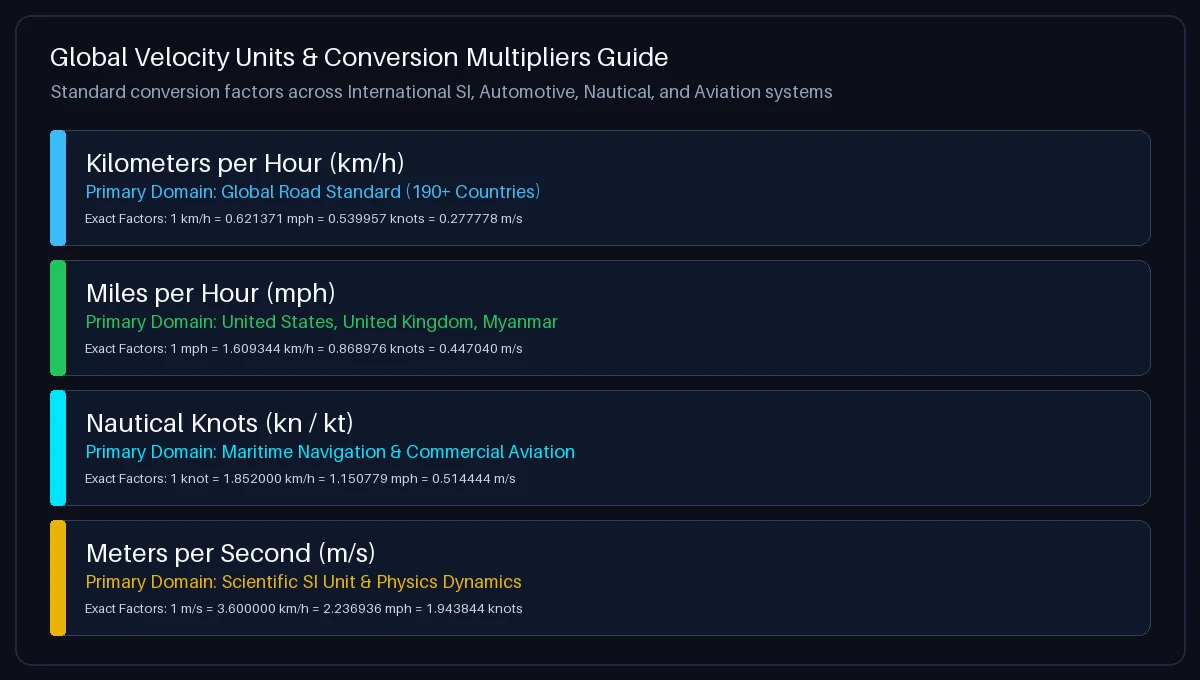
Explore how different industries and activities utilize speed conversions:
- Automotive Cross-Border Travel: When driving an American vehicle (MPH speedometer) into Canada or Mexico (KM/H speed signs), knowing key conversions prevents speeding fines. For example, a 100 km/h highway sign equals 62 mph, and a 50 km/h city limit equals 31 mph.
- Cycling & E-Bike Regulations: European Union EN15194 regulations cap legal e-bike motor assistance at 25 km/h (15.53 mph), while US Class 1 and Class 2 e-bikes are capped at 20 mph (32.19 km/h). Track your ride with our Bicycle Speedometer.
- Running Splits & Pacing: Runners frequently convert treadmill metric speeds to imperial pace splits. A treadmill set to 12 km/h (7.46 mph) corresponds to a 5:00 min/km or 8:03 min/mile split. Learn more in our Running Speed Guide.
- High-Speed Rail & Bullet Trains: Commercial bullet trains like France’s TGV and Japan’s Shinkansen cruise at 300 to 320 km/h (186 to 199 mph). Track live rail transit with our Train Speed Tracker.
- Commercial Aviation & Maritime Navigation: Passenger airliners cruising at 480 knots are traveling at 889 km/h or 552 mph.
For ongoing journey monitoring with max speed and trip distance, visit our Speed Tracker Telemetry Hub.
When Do You Need MPH vs. KM/H? Global Geographic Standards
Understanding which unit applies depends on geographic jurisdiction and industry standard:
- United States & UK (Miles per Hour): Road networks, automotive dashboards, radar enforcement, and national rail lines use imperial MPH.
- Continental Europe & Global (Kilometers per Hour): All highway signage, traffic camera calibration, and vehicle speedometers operate under metric KM/H (Vienna Convention on Road Traffic).
- International Aviation & Maritime (Knots): Global air traffic control (ICAO) and maritime navigators universally use nautical knots (1 knot = 1 nautical mile per hour = 1.852 km/h).
- Scientific Physics (Meters per Second): Academic physics, fluid dynamics, and aerodynamics utilize SI standard meters per second (1 m/s = 3.6 km/h).
Frequently Asked Questions About Speed Conversion
How do I convert MPH to KM/H?
To convert MPH to KM/H, multiply the speed value by 1.609344. For example, 60 mph × 1.609344 = 96.56 km/h. For quick mental math, multiply by 1.6.
How do I convert KM/H to MPH?
To convert KM/H to MPH, multiply the speed value by 0.621371 (or divide by 1.609344). For example, 100 km/h × 0.621371 = 62.14 mph. For quick mental math, multiply by 0.62.
What is 60 MPH in KM/H?
60 MPH is exactly 96.56064 KM/H (commonly rounded to 96.6 km/h).
What is 100 KM/H in MPH?
100 KM/H is exactly 62.1371 MPH (commonly rounded to 62.1 mph).
How many KM/H is 1 knot?
1 knot is equal to exactly 1.852 KM/H (or approximately 1.1508 MPH / 0.5144 m/s).
How do you convert Meters per Second (m/s) to KM/H?
To convert m/s to km/h, multiply the speed by 3.6. For example, 10 m/s × 3.6 = 36 km/h (approx. 22.37 mph).
Why does 1 mile equal 1.609344 kilometers?
In 1959, the International Yard and Pound Agreement defined 1 international yard as exactly 0.9144 meters. Because 1 statute mile equals 1,760 yards, 1 mile is mathematically defined as exactly 1,609.344 meters or 1.609344 km.
What is a quick mental trick to convert km/h to mph while driving?
A simple mental estimate: divide the km/h speed by 10 and multiply by 6, then add a tiny bit (e.g. 100 / 10 = 10 × 6 = 60 + 2 = 62 mph). Alternatively, use the Fibonacci sequence (30 km/h ≈ 19 mph, 50 km/h ≈ 31 mph, 80 km/h ≈ 50 mph, 130 km/h ≈ 80 mph).
Can I calculate live moving speed with this tool?
Yes! While this page provides an interactive manual conversion calculator, you can launch our live GPS Speedometer to measure real-time satellite speed automatically on your phone or tablet.
Do I need to download an application to convert speeds?
No. This speed converter runs directly in your mobile or desktop web browser. You can also save it as a Progressive Web App (PWA) for fast offline home-screen access.