Design
Display
Units
Speed is worked out on your device and never uploaded. The map loads tiles for your area from OpenStreetMap and Esri.
Trips are saved in this browser when you press Reset.
No saved trips yet.
How to Run a GPS Sprint Speed Test
- 1. Find open space
A track, field or quiet straight path with open sky. Buildings and trees make GPS readings jumpy.
- 2. Lock GPS first
Tap Start and wait until the GPS status shows a good signal before you run — this takes 10–30 seconds.
- 3. Hold the phone firmly
Use an armband or hold it in your hand. A loose pocket adds noise.
- 4. Sprint 30–60 m, then read Max
Run all-out for 5–8 seconds. Your Max speed is kept after you stop. Press Reset between attempts.
Phone GPS updates about once per second, so it can miss a very short peak. For a precise number, use the timed method below.
Timed Sprint Calculator
Measure a distance, have a friend time you with a stopwatch from a flying or standing start, and enter the results.
This gives your average speed over the distance. Your top speed is higher, because the first seconds are spent accelerating. A “flying” sprint — timing only the last 20–30 m after a run-up — gets closer to top speed.
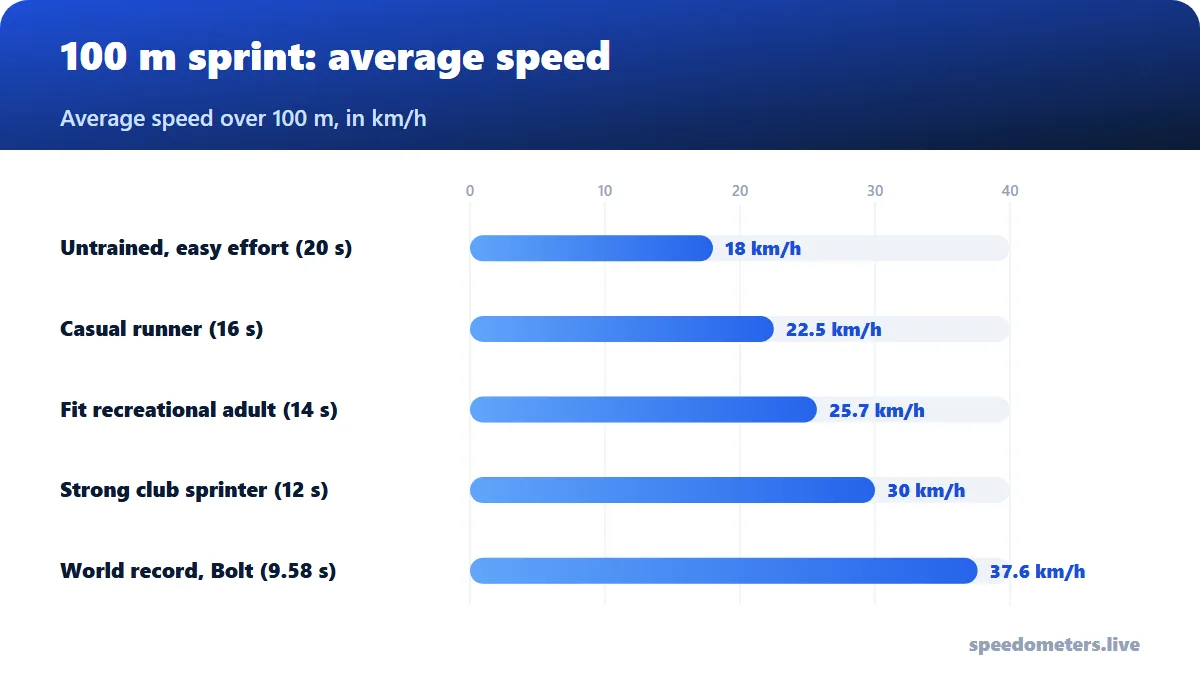
How Fast Is a Good Sprint?
| 100 m time | Average speed | Roughly comparable to |
|---|---|---|
| 9.58 s | 37.6 km/h · 23.3 mph | World record (Bolt, 2009) |
| 12 s | 30.0 km/h · 18.6 mph | Strong club sprinter |
| 14 s | 25.7 km/h · 16.0 mph | Fit recreational adult |
| 16 s | 22.5 km/h · 14.0 mph | Casual runner |
| 20 s | 18.0 km/h · 11.2 mph | Untrained / easy effort |
Compare with distance running in average running speed by age and sex.
Frequently Asked Questions
Can my phone measure my sprint speed?
Yes, roughly. GPS measures speed once per second, which works for sprints of 5 seconds or more. For short bursts, a timed distance is more precise.
How fast can a human run?
The fastest recorded human speed is about 44.7 km/h (27.8 mph), reached by Usain Bolt in 2009.
How do I convert my 100 m time to km/h?
Divide 360 by your time in seconds. For example, 360 ÷ 15 s = 24 km/h.
What about measuring running pace?
For steady runs, use the running speed tracker, which shows speed and pace per km or mile.