Design
Display
Units
Speed is worked out on your device and never uploaded. The map loads tiles for your area from OpenStreetMap and Esri.
Trips are saved in this browser when you press Reset.
No saved trips yet.
Speedometer Error Calculator
Hold a steady speed, ask a passenger to note both readings at the same moment, then enter them here.
How to Test Your Speedometer With GPS
- 1. Pick the right road
Avoid tunnels, tall buildings, overpasses and sharp bends. GPS is least accurate during acceleration and under obstructed sky.
- 2. Hold a steady speed
GPS updates about once a second. Compare only when the speed has been constant for several seconds.
- 3. Test several speeds
Speedometer error is usually a percentage, so it grows with speed. Three test speeds show the pattern.
- 4. Let a passenger read
Never look at your phone while driving. A passenger can read both values, or you can run the test from a dash mount and check the trip’s figures after stopping.
How Accurate Should a Speedometer Be?
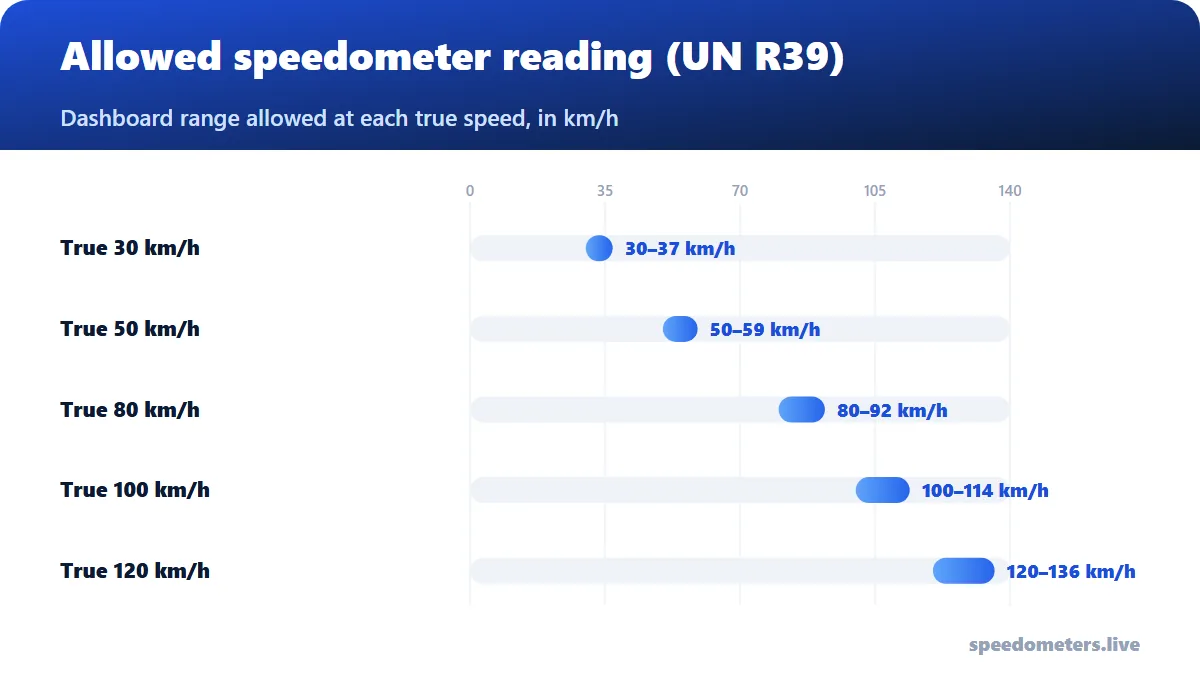
Because under-reading is not allowed, manufacturers build in a small margin, and most new cars read a few percent high. In the United States there is no federal accuracy limit for passenger-car speedometers; manufacturers follow industry practice. Read more in why car speedometers read high.
| True speed | Allowed dashboard range (UN R39) |
|---|---|
| 30 km/h | 30 – 37 km/h |
| 50 km/h | 50 – 59 km/h |
| 80 km/h | 80 – 92 km/h |
| 100 km/h | 100 – 114 km/h |
| 120 km/h | 120 – 136 km/h |
What Makes a Speedometer Inaccurate?
- Tire size: larger-diameter tires than stock make the speedometer read low; smaller ones make it read high. This is the most common cause after modifications.
- Tread wear and pressure: worn or under-inflated tires have a slightly smaller rolling radius, adding about 1–3%.
- Gear or differential changes: a different final-drive ratio changes the reading unless the car is recalibrated.
- Faulty sensors: a failing vehicle-speed or wheel-speed sensor causes erratic or zero readings.
Comparing GPS and dashboard? See GPS speed vs. speedometer: which is more accurate.
Check Any Speedometer: Car, Motorcycle, Bike or Boat
- Car speed test — compare your dashboard at highway speeds
- Motorcycle speedometer — motorcycles often over-read more than cars
- Bike speedometer — check a magnet-based bike computer’s wheel setting
- Boat speedometer — compare a paddle-wheel log with GPS speed over ground
Frequently Asked Questions
How do I check if my speedometer is accurate?
Compare it with GPS at a steady speed on an open road, then enter both values in the calculator on this page.
Is it normal for a speedometer to be off by 5 km/h?
At highway speeds, reading 3–6 km/h (2–4 mph) above true speed is common and legal. Reading below true speed is not normal.
Can a speedometer be recalibrated?
Yes. Modern cars are usually recalibrated in software with a diagnostic tool after a tire-size change; older cars may need a different drive gear or a calibration module.
Is a phone GPS accurate enough to test a speedometer?
At a constant speed in open sky, phone GPS is usually within about 1–2 km/h, which is enough to spot a meaningful speedometer error.