The Legal Rule Behind the Over-Reading
The rule is tested on new vehicles. Over the life of the car, tire wear makes the wheels slightly smaller, which pushes the reading up. A brand-new car calibrated to read exactly true would risk under-reading with fresh, larger tires — so manufacturers aim a little high from the start.
The United States has no federal accuracy limit for passenger-car speedometers, but US-market cars are generally built to a similar philosophy, and many read slightly high as well.
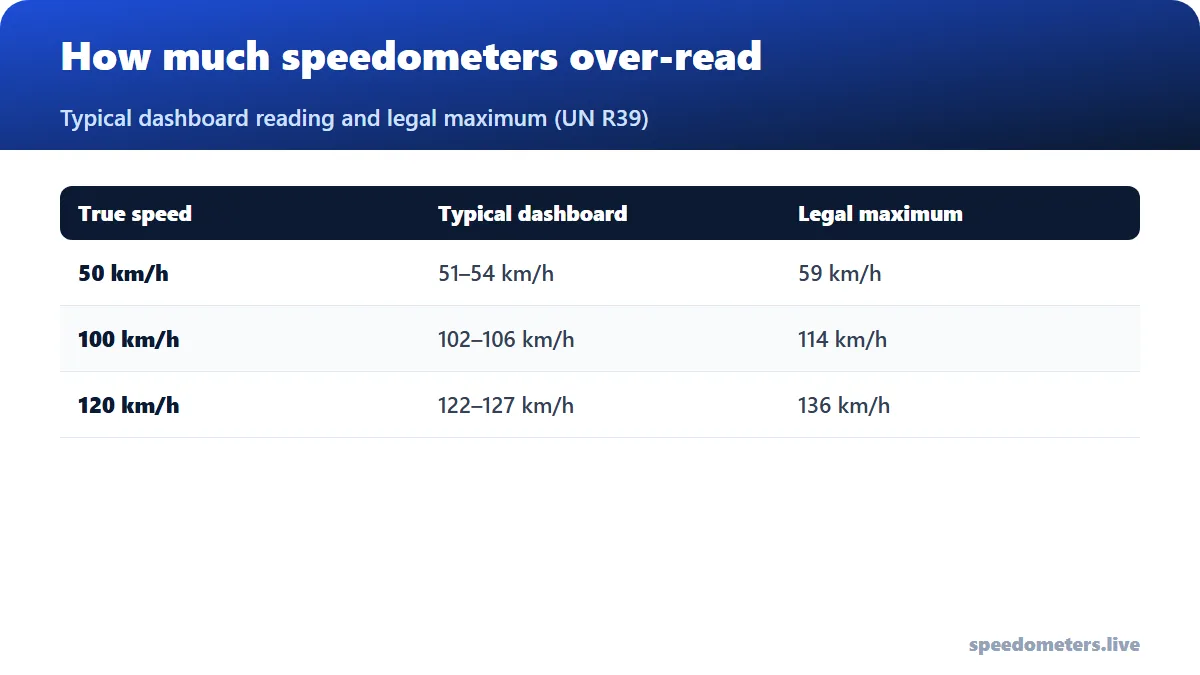
How Much Do Speedometers Typically Over-Read?
| True (GPS) speed | Typical dashboard | Legal maximum (UN R39) |
|---|---|---|
| 50 km/h (31 mph) | 51–54 km/h | 59 km/h |
| 100 km/h (62 mph) | 102–106 km/h | 114 km/h |
| 120 km/h (75 mph) | 122–127 km/h | 136 km/h |
“Typical” values vary by model and tire. Measure your own car with the speedometer accuracy check.
Other Reasons Your Speedometer Reads Fast
- Smaller tires than stock — fewer meters per wheel turn, so the car is slower than the gauge shows.
- Worn tread or low pressure — slightly smaller rolling radius.
- Winter or spare tires of a different size.
The opposite — larger wheels or tires than stock — makes the speedometer read low, which can mean you are speeding without knowing it.
Does It Matter for Speeding Tickets?
Many enforcement agencies also apply their own tolerance before issuing a ticket, but that tolerance varies by country and is not something to rely on.
Frequently Asked Questions
Why does my speedometer show a higher speed than GPS?
Because speedometers are designed never to under-read. GPS measures true speed, so it is usually a little lower than the dashboard.
Is 5 mph over normal?
At 70 mph a 2–4 mph over-read is common. Five mph or more at highway speed is on the high side — check tire size and pressure.
Do motorcycle speedometers read high too?
Yes, the same rule applies, and many motorcycles over-read more than cars. Check yours with the motorcycle speedometer.